Table of content


Use this liter to cubic centimeter converter to switch between L and cm³ (cc) instantly. Type a number, pick rounding if you want, and copy the result. Works for decimals, large values, and quick checks for school, labs, cooking, and product specs.
If you just need a quick answer, this tool is the fastest way to switch between liters (L) and cubic centimeters (cm³ / cc) without doing any manual math. Enter your value once, and you can re-check as many numbers as you like.
After you convert, it’s worth doing a quick sanity check: 1 L should become 1000 cm³, so your answer will usually look bigger when you move from liters to cubic centimeters. Also, cm³ and cc are the same size, so switching between them won’t change the number—only the label.
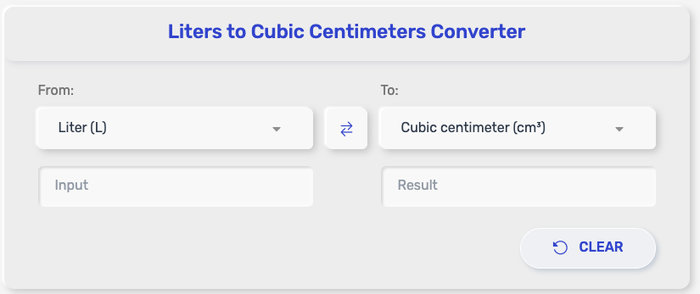
This converter covers the most common volume switches you’ll see in schoolwork, lab notes, product specs, and everyday measuring. It’s built for quick one-off conversions, but it also works smoothly when you’re checking a bunch of values in a row.
Convert L → cm³ and cm³ → L
Swap between liters and cubic centimeters in either direction, so you can start with whatever unit you already have.
Convert L → cc and cc → L (same numeric value as cm³)
If your source uses cc instead of cm³, you’ll get the same number—only the unit label changes.
Handle decimals, large values, and quick batch checks
Use small amounts like 0.25 L, bigger totals like 2500 L, or keep replacing the input to compare multiple entries fast.
Show rounded results (2, 3, or 4 decimal places)
Choose how clean you want the output to look. Keep more decimals for precision, or round down to keep the result easier to read.
The result you see is the same volume as your original input—just written in a different unit. Liters are bigger units, while cubic centimeters are smaller units, so the numeric value usually looks much larger after converting from L → cm³.
In the output label, cm³ means cubic centimeters. You may also see cc, which is a common shorthand for the exact same unit size. That means 1 cm³ = 1 cc, so the number won’t change if you switch between cm³ and cc—only the label does.
A couple quick reality checks can save you from a misplaced decimal:
1 L becomes 1000 cm³, so it should show as a 4-digit number.
Small amounts in liters turn into “tens” or “hundreds” in cm³. For example, 0.05 L = 50 cm³.
Rounding is optional, and it depends on what you’re doing. If you’re converting for everyday use like shopping, cooking, or comparing bottle sizes, rounding to 0–2 decimals is usually fine. For lab work, medicine dosing notes, or technical specs, keep more digits so you don’t lose precision.
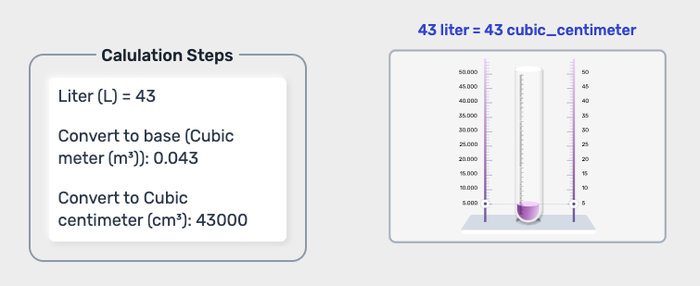
Before you convert, it’s useful to remember one simple relationship: liters are bigger units, and cubic centimeters are smaller units. So when you go from L → cm³, the number increases by a factor of 1000.
Core fact: 1 L = 1000 cm³
Liter to cubic centimeter: cm³ = L × 1000
Cubic centimeter to liter: L = cm³ ÷ 1000
If you ever want a fast mental check, move the decimal three places:
L → cm³: shift right 3 places (multiply by 1000)
cm³ → L: shift left 3 places (divide by 1000)
Sometimes you don’t need a full calculator run—you just want the common numbers at a glance. Here are a few of the most searched liter-to-cubic-centimeter conversions.
0.1 L → 100 cm³
0.25 L → 250 cm³
0.5 L → 500 cm³
1 L → 1000 cm³
2 L → 2000 cm³
Quick note: cc and cm³ match 1:1, so 250 cm³ is the same as 250 cc.
Bureau International des Poids et Mesures (BIPM) — The International System of Units (SI Brochure, 9th edition)
https://www.bipm.org/documents/20126/41483022/SI-Brochure-9-EN.pdf
National Institute of Standards and Technology (NIST) — The International System of Units (SI), 2019 Edition (NIST SP 330)
https://nvlpubs.nist.gov/nistpubs/SpecialPublications/NIST.SP.330-2019.pdf
National Institute of Standards and Technology (NIST) — Guide for the Use of the International System of Units (SI) (NIST SP 811)
https://physics.nist.gov/cuu/pdf/sp811.pdf
ISO — ISO 80000-3:2019, Quantities and units — Part 3: Space and time
https://www.iso.org/standard/64974.html
National Institute of Standards and Technology (NIST) — SI Unit rules and style conventions checklist
https://physics.nist.gov/cuu/Units/checklist.html
Yes. By definition, 1 L = 1000 cm³. So 2 L = 2000 cm³, 0.5 L = 500 cm³, and so on.
Yes. 1 cc = 1 cm³. The number stays the same—only the unit label changes.
Use cm³ = L × 1000. For example, 0.25 L × 1000 = 250 cm³.
Round if you’re doing everyday conversions (labels, recipes, quick comparisons). Keep more digits if the number comes from a precise measurement (lab notes, technical specs).
The unit conversion does not change: 1 L is still 1000 cm³. Temperature can change the physical volume of a liquid slightly as it expands or contracts, but the math between units stays the same.
That’s just another way to write large numbers. 1e3 means 1000. Many calculators switch to that format automatically.
Yes, indirectly. Since 1 mL = 1 cm³, you can treat milliliters as cubic centimeters. For example, 250 mL = 250 cm³ = 250 cc.
Litertocubiccentimeter.com is a simple online tool designed to help users quickly convert volume measurements from liters (L) to cubic centimeters (cm³). Whether you're working on school assignments, scientific calculations, engineering tasks, or everyday conversions, this tool provides fast and accurate results with a straightforward interface.
Our goal is to make unit conversion easy and accessible for everyone. With just a single input, users can instantly convert liters to cubic centimeters without complex formulas or manual calculations.
This tool was built to save time, improve accuracy, and provide a reliable resource for students, professionals, and anyone who needs quick volume conversions online.
Litertocubiccentimeter.com was developed and maintained by a dedicated team passionate about creating simple, practical online calculation tools that make everyday conversions easier.
We are committed to providing reliable, easy-to-use conversion tools while respecting user privacy and maintaining transparency.
Litertocubiccentimeter.com does not require account registration or personally identifiable information. Any values you enter for conversion are used only to generate instant results and are not stored or shared.
While this converter is based on the standard volume conversion formula between liters and cubic centimeters, results are intended for general informational and educational purposes only. Users should verify important measurements independently when conversions are used for scientific, academic, engineering, medical, or technical applications.
By using this tool, you agree to use it responsibly and understand that Litertocubiccentimeter.com is not liable for decisions, losses, or outcomes resulting solely from the use of calculated conversion results.
This tool was created and maintained by a dedicated team focused on building practical, accessible, and easy-to-use online conversion tools for students, professionals, and everyday users.
We may update this Policy periodically to reflect improvements to the tool, content updates, or changes in applicable standards and regulations. Any updates will be posted on this page to support continued transparency.